

Chesapeake Bay Retriever
Other Names: Chessie, CBR
Country of Origin: United States (Chesapeake Bay)
Accreditation:
American Kennel Club (AKC): Sporting
Canadian Kennel Club (CKC): Sporting
United Kennel Club (UKC): Gun Dog
Australian National Kennel Council (ANKC): Gun Dogs
The Kennel Club (KC): Gun Dogs
Kennel Union of Southern Africa (KUSA): Gun Dogs
National Kennel Club (NKC): Recognized
New Zealand Kennel Club (NZKC): Gun Dogs
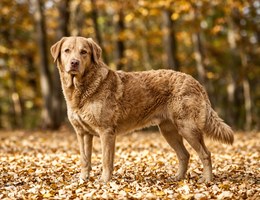
The Chesapeake Bay Retriever is a strong, slightly rectangular retrieving dog with a broad head, small dropped ears, and a harsh, oily coat that sheds water. The eyes are yellowish or amber, and the hindquarters are powerful.
A tough water retriever for a house that will swim and train him; a dense oily coat, a working voice, and too much drive for a still apartment.
- Height
- Male: 23–26 inches; Female: 21–24 inches
- Weight
- Male: 65–80 pounds; Female: 55–70 pounds
- Color
- Brown, sedge, or deadgrass; a small white spot on the chest or toes is allowed
- Coat
- Short, harsh outer coat with a dense, woolly, oily undercoat
- Lifespan
- 10–13 years
- Litter size
- 6–8 puppies
Temperament
Training
Care and grooming
Shedding
Health
Crosses that include the Chesapeake Bay Retriever
These hybrid pages list this breed as a parent. Open a name to see the other contributing breed.
Pup.com Copyright © 2007 - 2026 All Rights Reserved
Pup.com accepts no responsibility for the accuracy of the advertisements placed on the Pup.com website or for the contents of any website to which a hypertext link from Pup.com links. The Seller Ads and links to products and/or services are provided as a service, and Pup.com gives no warranties, expressed or implied, about the information and/or policies of the Seller Ads or the linked-to webites, or of the information shown.
Pup.com is the sole owner of the services and of all information provided by and posted to the Pup.com website. The use, reproduction, or storing of content for any purpose other than to contact a Seller, purchase a product or service, or compare prices is prohibited. You cannot use the information provided by Pup.com to recreate a directory, rebrand the informaton or redistribute the information in any way. Information provided by Pup.com is for individual, non-commercial use only. All information, processes and content contained within and that make up the services are the sole property of Pup.com. You may not reproduce, duplicate or redistribute any information provided by Pup.com for profit or personal gain of any kind. You may not frame any content or pages contained within the Pup.com website unless expressly granted permission by Pup.com.