

Catahoula Leopard Dog
Other Names: Louisiana Catahoula Leopard Dog, Louisiana Catahoula, Catahoula Cur, Catahoula Hound, Catahoula, Catahoula Hog Dog, Alapaha Blue Blood Bulldog
Country of Origin: United States
Accreditation:
American Kennel Club (AKC): FSS
United Kennel Club (UKC): Herding Dog
National Kennel Club (NKC): Recognized
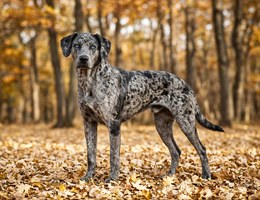
As a working dog, Catahoulas have been bred more for temperament and ability than for appearance. As a result, the physical characteristics of the Catahoula are somewhat varied. Their single, short, dense coat comes in a variety of colors. The term "leopard" refers to merles, but the Catahoula may also be of solid colors. No particular eye color is typical of Catahoulas; they can be brown, green, gray, or amber. They also may have "cracked glass" or "marbled glass" eyes (heterochromia), which occurs when both colored and glass portions are present in the same eye. Cracked or marbled eyes are blue or blue-white in color; or, in some cases, may be half of one color and half of another. The Catahoulas tail may be naturally long and whip-like reaching past the hocks of the back legs, or naturally bobtail. Catahoulas have prominent webbing between their toes, which extends almost to the end of the toes.
A Louisiana working dog for land and a job: short coat, a herding-and-hunting voice, and energy that sours in a quiet condo.
- Height
- 20-26 inches; Males: Average 24 inches
- Weight
- 50-90 pounds
- Color
- Merles of blue (mostly gray to mostly black color pattern, sometimes referred to as "gray leopard" or "black leopard"), gray, black, white (primarily white coat with some areas of leopard color), liver, red (varying shades of light reddish-brown with darker red or brown patches, sometimes referred to as "brown leopard" or "chocolate leopard", and patched (predominantly white with any color patches); solid colors of black, red, chocolate, yellow, and brindle, with trim colors of black, white, tan, red, or buff
- Coat
- Single, short, dense
- Lifespan
- 10–14 years
- Litter size
- 8–12 puppies
Temperament
Training
Care and grooming
Shedding
Health
Crosses that include the Catahoula Leopard Dog
These hybrid pages list this breed as a parent. Open a name to see the other contributing breed.
Pup.com Copyright © 2007 - 2026 All Rights Reserved
Pup.com accepts no responsibility for the accuracy of the advertisements placed on the Pup.com website or for the contents of any website to which a hypertext link from Pup.com links. The Seller Ads and links to products and/or services are provided as a service, and Pup.com gives no warranties, expressed or implied, about the information and/or policies of the Seller Ads or the linked-to webites, or of the information shown.
Pup.com is the sole owner of the services and of all information provided by and posted to the Pup.com website. The use, reproduction, or storing of content for any purpose other than to contact a Seller, purchase a product or service, or compare prices is prohibited. You cannot use the information provided by Pup.com to recreate a directory, rebrand the informaton or redistribute the information in any way. Information provided by Pup.com is for individual, non-commercial use only. All information, processes and content contained within and that make up the services are the sole property of Pup.com. You may not reproduce, duplicate or redistribute any information provided by Pup.com for profit or personal gain of any kind. You may not frame any content or pages contained within the Pup.com website unless expressly granted permission by Pup.com.